
Maryland Carry Update: The Supreme Court Passes on Novotny v. Moore — What Maryland Permit Holders Need to Know Now
By Evan Carson, Innovative Defensive Solutions — November 16, 2026
If you hold a Maryland Wear and Carry Permit, Monday’s news out of the U.S. Supreme Court matters — but not in the way a lot of social media graphics are making it sound.
On November 16, 2026, the Supreme Court denied review in Novotny v. Moore, No. 25-1324. That is not a ruling that Maryland’s law is constitutional. It is a refusal to take this case, in this form, at this time. The practical effect, though, is real: the Fourth Circuit’s ruling stays in place, and two restrictions that have been blocked for more than two years are expected to become enforceable again once the Fourth Circuit’s mandate issues.
Here is what actually happened, what stays banned, what is about to change, and the one big win that remains intact.
How we got here
In 2022, in New York State Rifle & Pistol Association v. Bruen, the Supreme Court held that the Second Amendment protects the right of law-abiding citizens to carry a handgun in public for self-defense, and that a carry restriction must be consistent with this nation’s historical tradition of firearm regulation.
Maryland responded in 2023 with Senate Bill 1, the so-called Gun Safety Act of 2023. Instead of denying permits outright, Maryland issued permits and then banned carry in a long list of places where people actually live their daily lives.
Two lawsuits were filed and consolidated:
- Novotny v. Moore — brought by Katherine Novotny, Susan Burke, and Esther Rossberg, together with Maryland Shall Issue, the Second Amendment Foundation (SAF), and the Firearms Policy Coalition (FPC)
- Kipke v. Moore — brought by Susannah Kipke and the Maryland State Rifle and Pistol Association
Gun Owners of America (GOA) was not a plaintiff, but GOA led an amicus — “friend of the court” — brief filed June 29, 2026, in support of the petitioners, joined by Gun Owners Foundation, the Virginia Citizens Defense League, and other state and national groups. GOA argued, among other things, that the Fourth Circuit’s decision created and deepened circuit splits on how Bruen applies to “sensitive places.”
FPC President Brandon Combs put the plaintiffs’ core argument this way when FPC petitioned the Supreme Court on May 20, 2026:
“When the Supreme Court held that states must issue carry licenses, Maryland simply banned carry everywhere people actually go instead. Same result, different method. That’s not following the law — that’s open defiance of the Supreme Court, and we’re going to make them answer for it.”
SAF Executive Director Adam Kraut made the same point in SAF’s filings:
“The Supreme Court has been clear that the Second Amendment protects a right for individuals to carry for self-defense as they go about their daily lives. Put bluntly, when forced by the Supreme Court to issue carry permits, Maryland simply made those permits useless everywhere.”
The rulings below the Supreme Court
A federal district court in Maryland split the difference first. On August 2, 2024, it held three provisions unconstitutional: the ban in locations selling alcohol for on-site consumption, the ban within 1,000 feet of a public demonstration, and the default ban on private property without the owner’s express permission.
On January 20, 2026, the Fourth Circuit — in the opinion captioned Kipke v. Moore, 165 F.4th 194 — reversed on the first two and upheld almost everything else. The Fourth Circuit held that each location Maryland listed was a “sensitive place.”
On March 2, 2026, the Fourth Circuit stayed its mandate. That stay is why, until now, the Maryland State Police have listed three restrictions as not enforceable pending Supreme Court review:
- Locations selling alcohol, Md. Code Ann., Crim. Law § 4-111(a)(2)(8)(i)
- Private buildings or property without the owner’s consent, Md. Code Ann., Crim. Law § 6-411
- Within 1,000 feet of a public demonstration, Md. Code Ann., Crim. Law § 4-208
What Justice Thomas actually said
No justice dissented from Monday’s denial in Novotny. Justice Clarence Thomas filed a statement respecting the denial — meaning he agreed this petition should not be granted, for a specific and narrow reason.
He was not endorsing Maryland’s law. He wrote:
“I am skeptical that each of these laws ‘is consistent with this Nation’s historical tradition of firearm regulation’ in ‘sensitive places.'”
“States have seized on the idea of ‘sensitive places’ to prohibit the peaceable carry of firearms in locations that bear little resemblance to legislatures, polling places, or courthouses.”
“Expanding the category of ‘sensitive places’ … to all places of public congregation … would eviscerate the general right to publicly carry arms for self-defense.”
“I harbor serious doubts that our Nation’s historical tradition of firearm regulation supports many of these sweeping restrictions.”
His reason for passing on this case was breadth: “Because each Maryland statute implicates a distinct historical tradition of firearm regulation, the breadth of petitioners’ challenge would complicate our review.”
His closing line is the roadmap for the next case:
“In an appropriate and more narrowly focused case, however, we should consider the scope of States’ authority to ban firearms in ‘sensitive places.'”
GOA highlighted that full statement on November 16. SAF, reacting to the denial, expressed disappointment and pointed to its separate challenge to New York’s ban on carry in public parks, which is also pending before the Court, with SAF’s Bill Sack saying SAF is hopeful the Court “takes a very hard look at that case and elects to restore the right to carry.”
In other words: the fight over sensitive places is not over. This vehicle was judged too broad. A narrower, single-location challenge is what Thomas is inviting.
What remains banned in Maryland right now
Under the Fourth Circuit ruling left in place, Maryland’s bans were upheld for:
- Government buildings
- Schools and school grounds
- Healthcare facilities
- Mass transit facilities
- State parks, state forests, and Chesapeake forest lands
- Museums
- Stadiums, racetracks, amusement parks, and casinos — Maryland’s “places of amusement”
- Locations selling alcohol for on-site consumption (see timing note below)
- Within 1,000 feet of a public demonstration (see timing and detail note below)
This list is not all-inclusive. Maryland’s prohibited-places rules appear in multiple statutes and regulations. Check the Maryland State Police Wear and Carry / Prohibited Places guidance before you carry — that is the official, current source.
What is expected to change next — read this carefully
The graphic circulating online is directionally right on this point, but it leaves out timing and detail that matter if you carry:
- Bars and restaurants licensed for on-site alcohol consumption
This ban was blocked by the district court and has been listed by the State Police as unenforceable while the stay was in place. The Fourth Circuit upheld it. Once the Fourth Circuit mandate issues following the Supreme Court’s denial, it is expected to be enforceable again. As of November 16, the State Police page had not yet been updated to reflect the denial — it still described the restriction as unenforceable pending review. Do not rely on a screenshot or a social post for the switch-over date. Watch for the mandate and updated Maryland State Police guidance. - Within 1,000 feet of a public demonstration
Same procedural posture: upheld by the Fourth Circuit, unenforceable during the stay, expected to be enforceable again once the mandate issues.
And this rule is narrower than most graphics describe it. Under Md. Crim. Law § 4-208, it is not an automatic ban around any gathering, festival, or event. It applies to a demonstration in a public place, and only after a law enforcement officer advises you that a demonstration is occurring and orders you to leave the area until you dispose of the firearm.
The big win that remains: ordinary private businesses open to the public
Maryland’s default ban — sometimes called the “vampire rule” — remains blocked.
Maryland had made it a crime to carry into a private building or property open to the public unless the owner gave express permission. The district court blocked it, the Fourth Circuit affirmed that block, and that was the one locational restriction the Fourth Circuit did not uphold.
That result was then reinforced nationally on June 25, 2026, when the Supreme Court decided Wolford v. Lopez, 6-3, striking down Hawaii’s nearly identical default ban on carry in private businesses open to the public without the owner’s express permission.
Maryland then dropped its own appeal of the private-property ruling: the state’s petition in Moore v. Kipke, No. 25-1206, was dismissed on August 13, 2026, on a joint stipulation filed August 10.
What this does not mean: a property owner cannot prohibit firearms. An owner can still say no, post a prohibition, and use trespass law. What the state cannot do is make “no carry” the default for every ordinary store, restaurant, and business open to the public, and force lawful permit holders to get invited in first.
What this means for you if you carry in Maryland
- A denial of certiorari is not approval. The Supreme Court did not hold Maryland’s list constitutional. It left a Fourth Circuit decision standing, which binds Maryland but does not settle the question nationally.
- Assume the alcohol-location and demonstration restrictions will return to enforcement shortly. Plan your carry accordingly now, and confirm the exact effective status on the Maryland State Police site before you go.
- The rest of the list never left. Government buildings, schools, healthcare facilities, mass transit, state parks and forests, museums, and places of amusement have remained prohibited under the rulings in this case.
- Private businesses open to the public are different. The state’s default ban remains blocked. The individual owner’s decision still controls on his or her own property.
- This is general information, not legal advice. Carry law in Maryland is statute-by-statute and is changing with the mandate in this case. If you have a specific situation, talk to a Maryland firearms attorney.
Bottom line
Maryland won this round on procedure and breadth, not on a Supreme Court endorsement of its map of gun-free zones. FPC, SAF, Maryland Shall Issue, and the other plaintiffs lost the broad challenge. GOA and its fellow amici did not get the review they urged. Justice Thomas, in writing, said he has “serious doubts” about many of these restrictions and that the Court should take the question up in a narrower case.
Until that case arrives, Maryland permit holders have to live with the Fourth Circuit’s list — and pay close attention in the next days and weeks to the mandate and to Maryland State Police guidance on the two restrictions that have been paused since 2024.
If you are interested in Maryland HQL or Maryland Wear and Carry training, go to Dave Ritchie at Free State Defensive Firearm Training. Dave is a friend and former IDS adjunct instructor, and we still train and work together and have a great partnership.
— Evan
Sources
Supreme Court docket, Novotny v. Moore, No. 25-1324 — petition denied November 16, 2026; Statement of Justice Thomas respecting the denial of certiorari: https://www.supremecourt.gov/Search.aspx?FileName=/docket/docketfiles/html/public/25-1324.html
Justice Thomas statement, full text via Reason / Volokh Conspiracy, November 16, 2026: https://reason.com/volokh/2026/11/16/justice-thomas-on-the-second-amendment-in-sensitive-places/?comments=true
Firearms Policy Coalition — Novotny v. Moore case page: https://www.firearmspolicy.org/novotny
Firearms Policy Coalition — “FPC Asks Supreme Court to End Maryland’s Public Carry Bans,” May 20, 2026: https://www.firearmspolicy.org/fpc-asks-supreme-court-to-end-marylands-public-carry-bans
Second Amendment Foundation — “SAF Files Reply Brief With Supreme Court in ‘Sensitive Places’ Challenge,” September 2, 2026: https://saf.org/saf-files-reply-brief-with-supreme-court-in-sensitive-places-challenge/
Gun Owners of America et al., Amicus Brief in Support of Petitioners, Novotny v. Moore, No. 25-1324, June 29, 2026: https://www.supremecourt.gov/DocketPDF/25/25-1324/415277/20260629145404698_Novotny%20Petition%20amicus%20brief.pdf
Maryland State Police — Handgun Wear and Carry Permit / Kipke v. Moore guidance (page as checked November 16, 2026 — update pending): https://test-mdsp.maryland.gov/Organization/Pages/CriminalInvestigationBureau/LicensingDivision/Firearms/WearandCarryPermit.aspx
Reuters, November 16, 2026 — “US Supreme Court sidesteps fight over Maryland’s ‘sensitive places’ gun curbs”: https://kwsn.com/2026/11/16/us-supreme-court-sidesteps-fight-over-marylands-sensitive-places-gun-curbs/
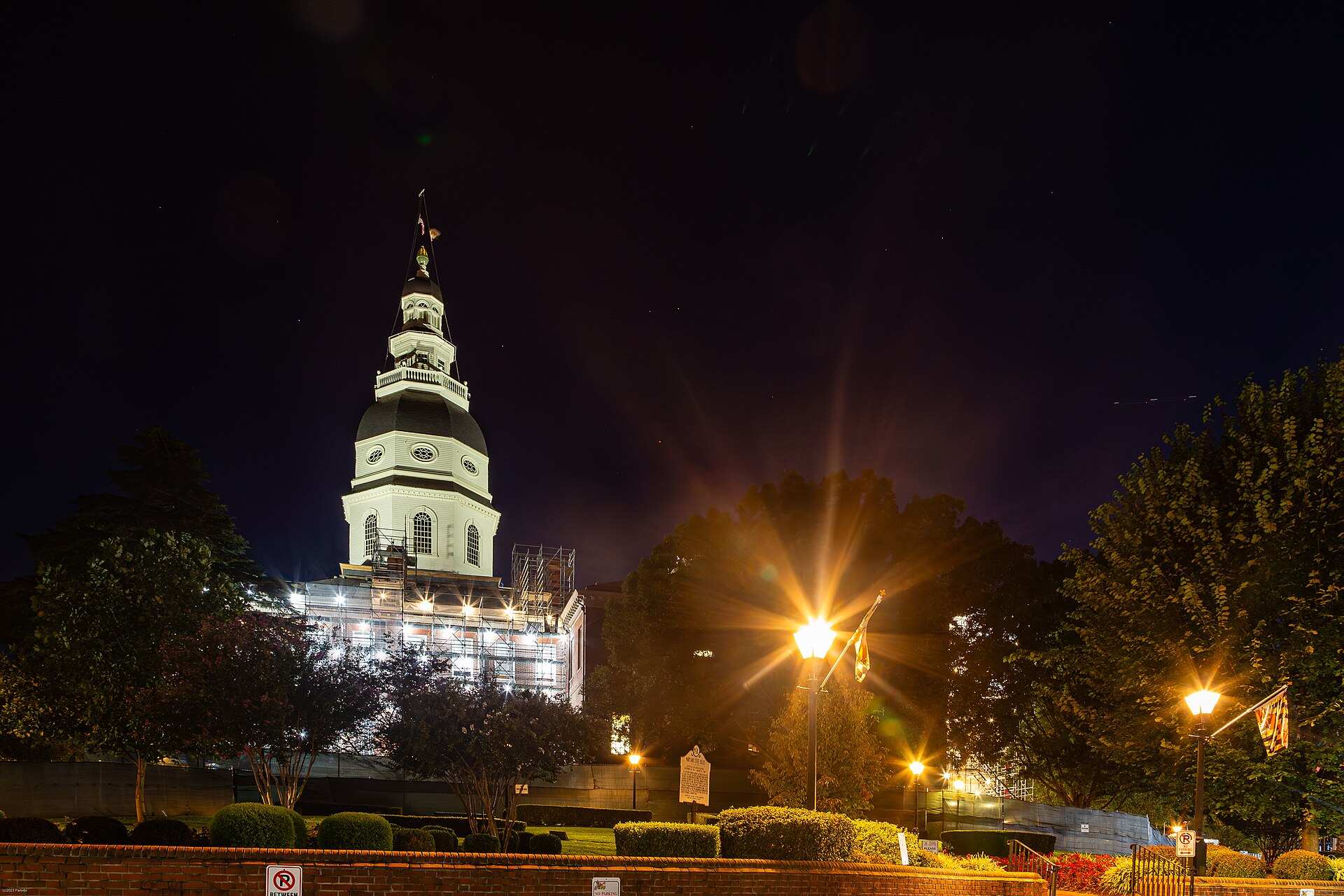
Featured photo: Maryland State House, Annapolis — Andrew Parlette, CC BY 2.0, via Wikimedia Commons.

